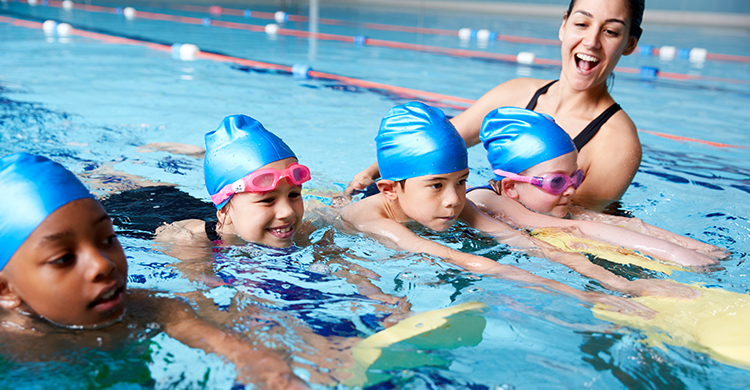
Summer is here, and with school holidays in full swing, many children across Dumfries & Galloway are spending more time in the water — whether that’s a local pool, a holiday park like Brighouse Bay or Auchenlarie, or the beach at Sandyhills. It’s the time of year when parents often start asking: how long before my child can actually swim properly?
The honest answer is that there’s no single timeline. But there is a typical journey, and understanding the stages can help you feel far less worried when your child seems to be taking their time.
Water confidence and floating: where it all starts
Before any stroke technique comes trust — trust in the water, in their instructor, and in themselves. Young children, often from as early as three or four years old, begin by simply getting comfortable: blowing bubbles, splashing, and learning that water is something to enjoy rather than fear.
Floating is usually one of the first real skills. Being able to float on their back — calmly, without gripping the instructor — is a significant moment. It tells us a child’s body is relaxed in the water, which is the foundation everything else is built on.
Some children take to this within a few lessons. Others need several months, especially if they’ve had a frightening experience near water, or simply have a more cautious temperament. Neither is a cause for concern.
Building stroke technique: backstroke and breaststroke first
Once a child is genuinely comfortable and can float with confidence, instructors typically introduce backstroke before breaststroke — and breaststroke before front crawl. This often surprises parents, but there are good reasons for the order.
Backstroke keeps the face out of the water, which reduces anxiety for children still getting used to submersion. It also builds the arm and leg coordination needed for more complex strokes later on. Breaststroke follows because its symmetrical movements are more natural and easier to coordinate than the alternating actions of front crawl.
By the time a child is working on breaststroke — often somewhere between ages six and nine, though this varies widely — they’re already building real swimming ability. Many children at this stage can cover a length or more with growing confidence.
Front crawl readiness: the skills your child needs
So when do children learn front crawl swimming? Realistically, most children aren’t ready to begin working on front crawl until they can already swim at least a width comfortably using another stroke, turn their head to breathe without panicking, and kick with a reasonably steady rhythm.
The breathing is the hardest part. Front crawl requires a child to rotate their head to the side to breathe — not lift it upwards — while keeping their body moving forward. This is genuinely tricky to coordinate, even for older children. Rushing into front crawl before those foundations are in place usually just leads to frustration on both sides.
Most children begin working on front crawl somewhere between the ages of seven and ten, though some confident swimmers reach it earlier, and plenty of older children are still developing it in their teens. That’s completely normal.
Timeline milestones and why children progress at different speeds
A rough guide might look like this: water confidence and floating in the first one to two years of lessons, backstroke developing from around age five or six, breaststroke following over the next year or two, and front crawl beginning to take shape from around seven or eight onwards. But these are rough markers, not targets to stress about.
Children who swim weekly tend to progress faster than those who have gaps between lessons — a summer at a holiday park pool can be brilliant for consolidating skills, but it’s not a substitute for consistent structured lessons. Children who are nervous in water, or who simply develop physical coordination skills a little later, may take longer at each stage. That doesn’t mean they won’t get there.
If your child seems stuck at one stage for a long time, the most useful thing is usually a conversation with their instructor. There may be a specific skill — perhaps submersion, or kicking technique — that’s holding things back, and which can be targeted directly. Signs that a child isn’t quite ready to move on often include consistent tension in the body, reluctance to put their face in the water, or an inability to maintain any kind of float without support.
How to support your child’s swimming journey at home
You don’t need a pool at home to help. Encouraging bath-time games that involve water on the face, talking positively about swimming lessons, and avoiding any suggestion that being slower than another child is a problem — all of these make a real difference.
If you’re spending time near water this summer — at Sandyhills beach, or at one of the holiday park pools along the Solway coast — let your child lead. Free play in shallow water builds confidence in a way that’s hard to replicate in a lesson setting. Keep it relaxed and pressure-free.
Above all, remember that the goal isn’t front crawl for its own sake. It’s a child who feels safe, capable, and happy in the water. The strokes will follow.