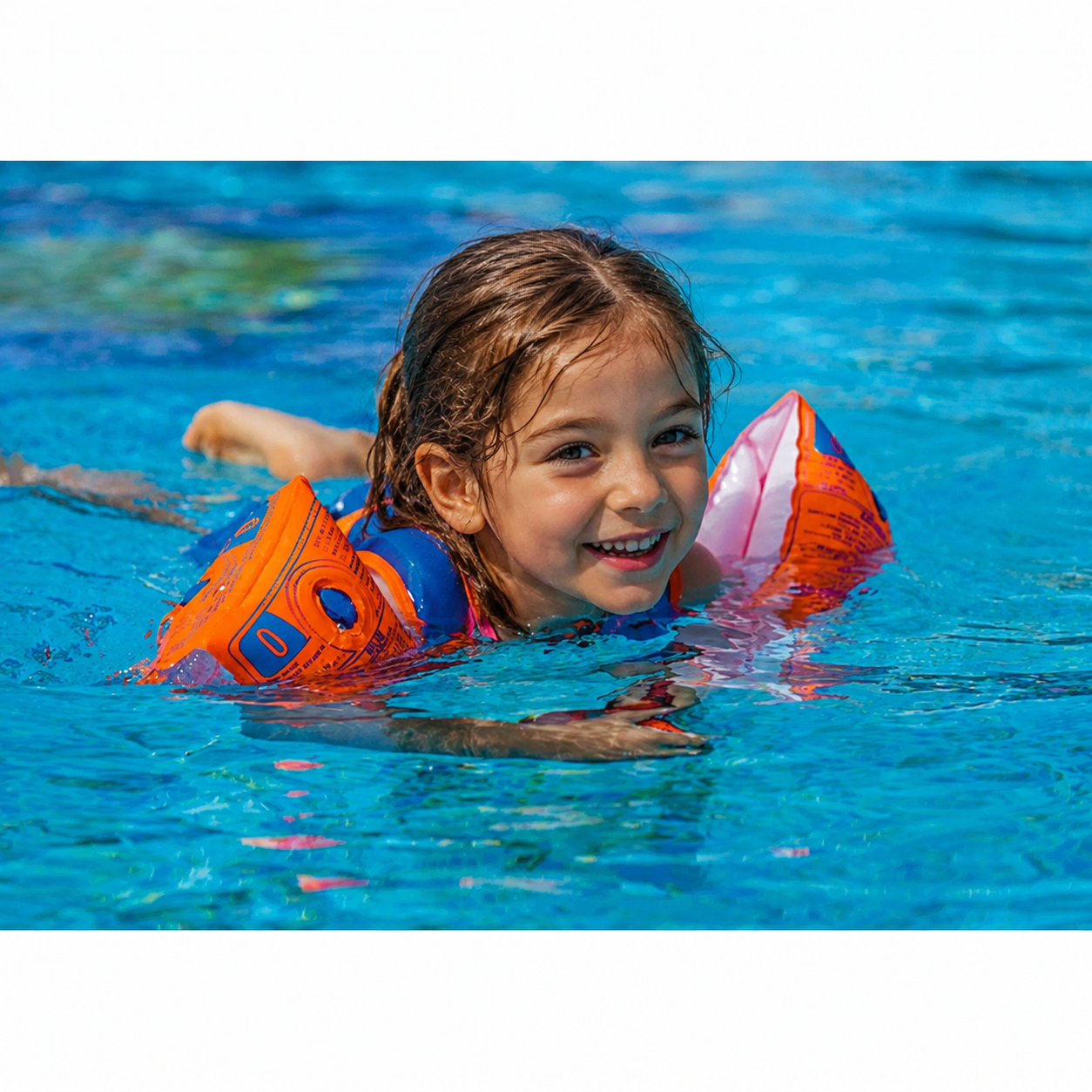
With the summer holidays in full swing, pools across Dumfries & Galloway are busier than ever. Whether your child is splashing about at a holiday park pool or having their first proper lessons, the question of armbands comes up constantly. Are they helping or are they quietly getting in the way?
The honest answer is: both, depending on the stage your child is at. There’s no need to feel guilty if your little one is still wearing them — they’ve served a real purpose. But understanding when to move on makes all the difference.
When Armbands Actually Help (and Build Confidence)
For very young children who are new to the water, armbands offer something genuinely valuable: buoyancy that lets them focus on the fun rather than the fear. When a child isn’t constantly worried about sinking, they relax — and relaxed children learn faster.
In the early stages, that confidence matters enormously. A child who enjoys the water will want to be in it more often, and time in the water is never wasted. So no, you haven’t done anything wrong by using armbands to get things started.
Why Armbands Can Slow Down Progress
Here’s where it gets nuanced. Armbands hold the arms rigid and push the body into a near-vertical position in the water. That’s the opposite of the horizontal, streamlined position needed for almost every swimming stroke.
Children who rely on armbands for a long time often develop a cycling or running motion with their legs rather than an effective kick. They can also struggle to put their face in the water — a fundamental skill — because armbands give them a false sense of where the surface is. So yes, worn for too long, they do get in the way of proper technique.
The Transition Point: When to Move Away from Them
Most children are ready to start reducing their reliance on armbands somewhere between ages four and six, though this varies hugely. There’s no fixed rule, and we’d always rather base it on the individual child than any arbitrary age.
Signs your child might be ready include: pushing off the wall and gliding independently, kicking with some rhythm and control, and showing willingness to put their face in the water. If they’re doing all three, it’s time to start weaning off — gradually, not all at once.
The transition works best in stages. Letting some air out of the armbands over several sessions is one method; moving to a single disc float or woggles is another. The goal is to reduce the buoyancy slowly so the body learns to find its own balance.
What to Use Instead of Armbands
There are better alternatives that encourage proper body position from the start. Woggles (pool noodles) are brilliant because children can hold them in different ways and the support isn’t fixed — they have to work a little to stay balanced. Kickboards help children practise leg kick while keeping the head up or down.
Swim vests or jackets are worth a mention too. Unlike armbands, a well-fitted swim vest distributes buoyancy more evenly across the torso, allowing the arms to move freely and the body to sit in a more natural position. They’re a useful middle ground, particularly for younger children who still need some reassurance in open or unfamiliar water.
How Rebecca Uses Armbands in Lessons
In our lessons at Auchenlarie Holiday Park and Castle Cary Holiday Park here in Dumfries & Galloway, we take a very individual approach. We might use armbands briefly with a nervous beginner to help them settle, but we introduce alternatives early and phase buoyancy aids out as soon as a child is ready.
We follow Scottish Swimming’s learn-to-swim framework, which prioritises water confidence alongside proper technique from the start. The aim is always independent swimming — children who can genuinely keep themselves safe in the water, not just float with help.
If you’re not sure where your child is in their swimming journey, or you’d like to know whether they’re ready to ditch the armbands, we’re happy to chat. Get in touch with Rebecca to find out about lessons this summer — spaces are limited during the school holidays, so it’s worth getting in touch soon.